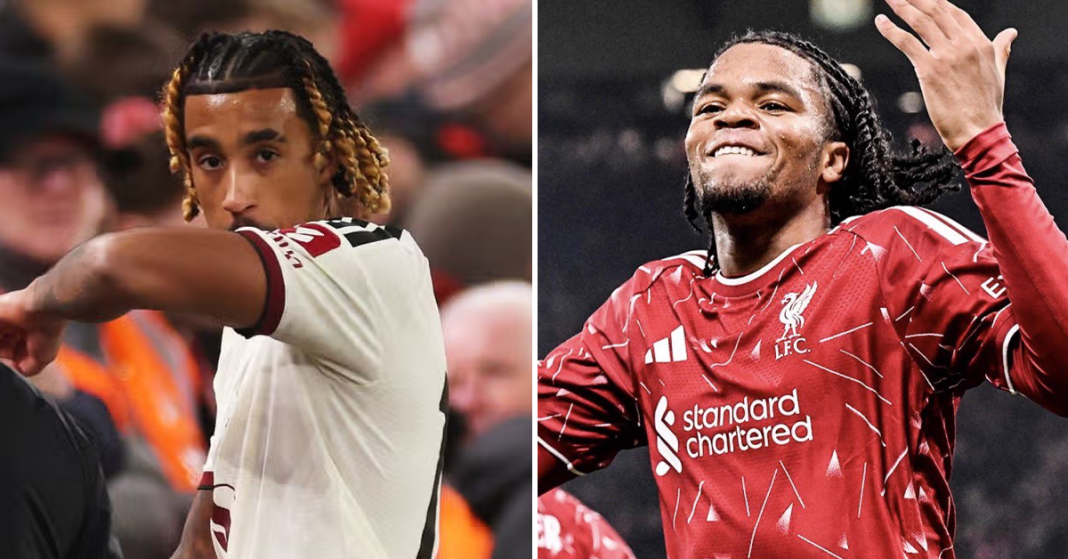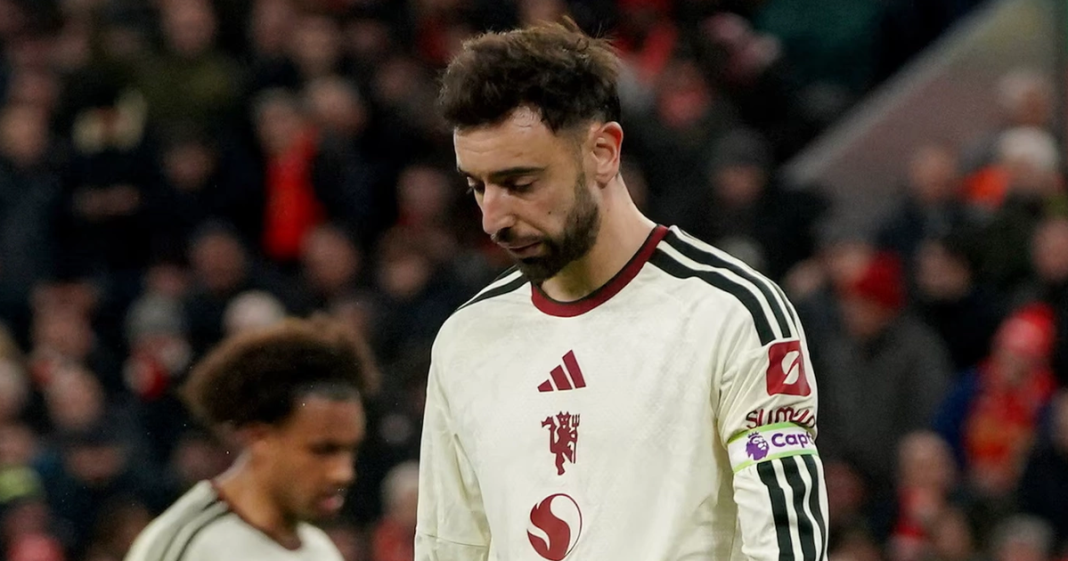
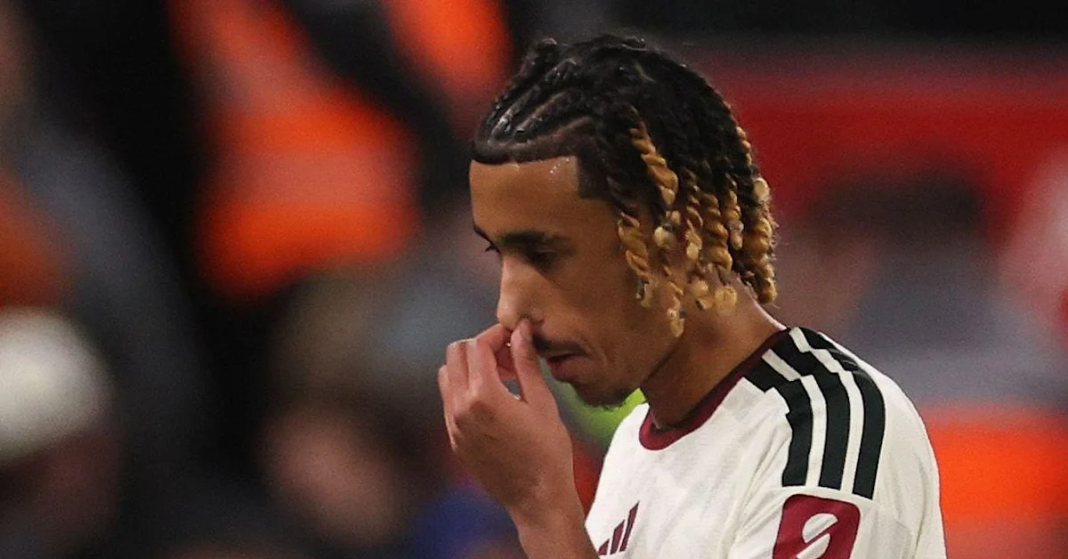
The Premier League has issued an official explanation for Leny Yoro’s controversial red card during Manchester United’s humiliating 4-0 defeat to Liverpool at Anfield. Despite strong protests from Mauricio Pochettino and several United figures, VAR backed referee Sam Barrott’s decision to send off the French defender just eight minutes into the match.
Manchester United endured a disastrous afternoon on Sunday, November 22, as Pochettino’s first match in charge ended in a crushing defeat against their biggest rivals.
However, the result was overshadowed by a controversial refereeing decision that effectively ended United’s hopes of securing a positive result before the game had even reached the ten-minute mark.
Premier League confirms why Leny Yoro was sent off against Liverpool
The incident occurred in the eighth minute when Liverpool striker Alexander Isak broke through Manchester United’s defensive line following a mistake from Matthijs de Ligt.
As Isak raced towards goal, Yoro attempted to recover his position but collided with the Swedish striker just outside the penalty area.
Referee Sam Barrott immediately awarded Liverpool a free-kick and showed the 21-year-old defender a straight red card for denying an obvious goalscoring opportunity, commonly known as DOGSO.
VAR subsequently reviewed the incident but decided not to overturn the original decision.
Following the controversy, the Premier League Match Centre released an official explanation on social media, confirming that the match officials had agreed with the decision.
“The referee’s call of red card to Yoro for denial of an obvious goal-scoring opportunity (DOGSO) was checked and confirmed by VAR.”
The Premier League also published details of the communication between referee Sam Barrott and the video assistant referee.
Barrott confirmed that he considered the incident a DOGSO offence outside the penalty area and therefore worthy of a straight red card.
The VAR agreed that Yoro had made sufficient contact with Isak from behind after getting too close to the Liverpool striker.
Consequently, the original decision stood, leaving Manchester United with ten players for more than 80 minutes.
The explanation confirms that the officials considered the challenge a foul that denied Isak a clear goalscoring opportunity. However, it has done little to settle the debate over whether the Liverpool striker would actually have reached the ball before goalkeeper Senne Lammens.
Why is Leny Yoro’s red card so controversial?
The central argument concerns Isak’s first touch immediately before the collision.
Although the Liverpool striker had moved beyond Manchester United’s defensive line, his touch sent the ball towards the advancing Lammens.
Manchester United believe the goalkeeper was in a position to collect the ball before Isak could regain possession, meaning the incident should not necessarily have been classified as the denial of an obvious goalscoring opportunity.
According to Law 12 of the IFAB Laws of the Game, referees must consider four main factors when assessing a potential DOGSO offence:
- The distance between the offence and the goal.
- The general direction of play.
- The likelihood of the attacking player keeping or gaining control of the ball.
- The location and number of defenders.
In this particular incident, the most disputed factor was whether Isak was likely to regain control of the ball before Lammens could intervene.
While Isak was moving towards goal in a dangerous central position without another covering defender, his heavy touch created uncertainty about whether a clear goalscoring chance would have developed.
That distinction is crucial. A foul against an attacker does not automatically constitute a DOGSO offence simply because the defending player is the last man.
Nevertheless, the VAR officials concluded that the on-field decision should stand, and Yoro was forced to leave the pitch.
Mauricio Pochettino furious with controversial decision
Manchester United head coach Mauricio Pochettino strongly disagreed with the referee’s interpretation after watching his side suffer a 4-0 defeat.
Speaking to Sky Sports, the Argentine insisted that Isak’s heavy touch had taken the ball into the goalkeeper’s path.
“The ball was for the goalkeeper.”
Pochettino argued that Yoro had not deliberately attempted to bring down the Liverpool striker and believed the officials had misjudged the situation.
The United manager described the circumstances as unfair, although he also acknowledged that his players needed to take responsibility for their performance.
He additionally questioned another refereeing decision earlier in the game, claiming Manchester United should have been awarded a penalty following Jérémy Jacquet’s challenge on Bryan Mbeumo.
According to Pochettino, a penalty in United’s favour could have completely changed the course of the match before Yoro’s dismissal.
However, the alleged penalty incident remains a separate refereeing controversy, and Pochettino’s assessment does not establish that the officials made an error.
Kobbie Mainoo and Roy Keane question the red card
Pochettino was not alone in disputing the decision.
Manchester United midfielder Kobbie Mainoo also expressed his frustration, arguing that Isak had already lost control of the ball before the collision.
Mainoo suggested that the goalkeeper was the favourite to collect the ball, making a straight red card an excessively harsh punishment.
Former Manchester United captain Roy Keane shared a similar opinion during Sky Sports’ post-match analysis.
Keane believed that Isak was unlikely to reach the ball ahead of Lammens, although he was also critical of United’s defending in the build-up to the incident.
However, not everyone agreed with the Manchester United perspective.
Gary Neville supported the dismissal, criticising Yoro’s positioning and his failure to anticipate the danger. Former Liverpool midfielder Danny Murphy also believed the red card was justified.
The contrasting reactions demonstrate why the DOGSO interpretation has become such a major talking point following the match.
Leny Yoro’s dismissal destroys Pochettino’s game plan
The impact of the decision was immediate.
Dominik Szoboszlai stepped up to take the resulting free-kick and produced an excellent finish to give Liverpool the lead.
Florian Wirtz doubled the advantage in the 13th minute, leaving Manchester United facing a two-goal deficit while playing with ten men.
Pochettino was subsequently forced into an early tactical adjustment, withdrawing Bryan Mbeumo and introducing Harry Maguire in the 22nd minute to reinforce United’s depleted defence.
Despite the change, Liverpool remained firmly in control.
Rio Ngumoha scored Liverpool’s third goal in the second half before substitute Víctor Muñoz completed the scoring, sealing a comprehensive 4-0 victory at Anfield.
The result left Manchester United in 19th place in the Premier League with just eight points from their opening 11 matches.
Will PGMOL apologise for Leny Yoro’s red card?
For now, there is no confirmed indication that the refereeing authorities intend to reverse their assessment of the incident.
The explanation published by the Premier League Match Centre supports the decision made by Sam Barrott and confirmed by VAR.
As of November 23, no separate PGMOL apology or formal admission of an officiating error has been confirmed in the official material reviewed.
That does not necessarily mean the controversy is over. Manchester United could still seek clarification or consider the available disciplinary procedures regarding Yoro’s dismissal.
However, any potential appeal would be a separate process, and the Premier League’s published explanation should not be confused with a final ruling on an appeal.
Another major problem for Manchester United
The controversial dismissal adds another layer of frustration to what has already become a deeply disappointing season for Manchester United.
Yoro’s red card was his second dismissal of the campaign, having previously been sent off against Atletico Madrid in the Champions League.
For Pochettino, the immediate challenge is to restore discipline, confidence and defensive stability within a team struggling near the bottom of the Premier League table.
While United can reasonably question whether Isak would have reached the ball before Lammens, their problems extend far beyond a single refereeing decision.
The Premier League has made its position clear: VAR supported the referee’s decision.
Whether Manchester United accept that explanation or seek to challenge Yoro’s punishment remains to be seen.