FIFA affirms VAR acted correctly when causing Breel Embolo to receive a second yellow card in the match between Switzerland and Argentina at the 2026 World Cup.
FIFA has officially spoken out regarding the incident in which Breel Embolo was sent off in the 2026 World Cup quarter-final match between Switzerland and Argentina.

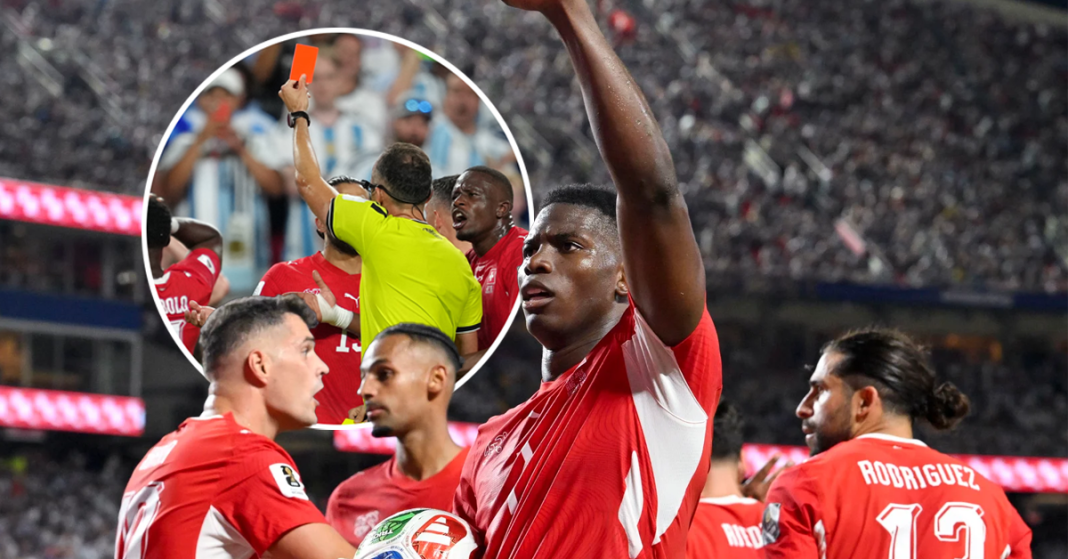
Controversy arose immediately following Switzerland’s equalizer. In a collision between Embolo and Leandro Paredes, the referee deemed that the Argentine midfielder had committed a foul and issued a yellow card.
However, the VAR team subsequently intervened on the grounds of “mistaken identity”. After reviewing the incident, the referee determined that Paredes did not commit a foul, while Embolo had intentionally gone to ground to seek a favorable decision.
Paredes’ yellow card was rescinded. Embolo received a yellow card for simulation, which was also his second warning of the match. The Swiss forward had to leave the pitch, leaving his team down a man for the remainder of the game.
This decision immediately sparked controversy because VAR is not normally permitted to intervene in a situation that only leads to a yellow card. The issue became even more complex as shifting the punishment from Paredes to Embolo directly resulted in a red card.
In its latest response, FIFA affirmed that the protocol was applied correctly and consistently at the 2026 World Cup. World football’s governing body argued that a player should not be punished for an opponent’s simulation, especially when that card could lead to a sending-off or suspension due to card accumulation.
/origin-imgresizer.tntsports.io/2026/07/12/image-b7cd104d-0429-4e1b-8ddd-fe61036ee48f-85-2560-1440.jpeg "FIFA officially explains red card helping Argentina advance 2")
FIFA argued that rescinding Paredes’ card and transferring the penalty to Embolo restored fairness.
According to FIFA, VAR’s intervention “restored fairness” to the situation. The organization also did not view the referee’s initial decision as a serious error, as his direct line of sight made it difficult to accurately determine the sequence of events.
Even so, FIFA’s explanation has failed to close the debate. According to IFAB guidelines, VAR can intervene when the referee penalizes the wrong player, but only to identify the person who committed the penalized act.
In this instance, VAR did not merely rescind Paredes’ card but also re-evaluated the nature of the situation before transferring the punishment to Embolo for simulation. This is precisely what led refereeing circles and the media to question the limits of technological intervention.
FIFA stated it consulted with IFAB during the tournament and received confirmation that the above handling was valid. However, Embolo’s situation will still be brought up for review by both parties during the review of VAR protocols.
FIFA’s response defends the decision made on the field, but at the same time reveals that loopholes still exist in the rules. When a yellow card situation can be reviewed by VAR and indirectly result in a red card, the boundaries of intervention need to be more clearly defined to avoid differing interpretations.