Despite winning 3-0 against Scotland in Group C of the 2026 World Cup, the Brazilian Football Confederation (CBF) still filed a complaint with FIFA, demanding the suspension of referee Cesar Ramos and mentioning Lionel Messi in the complaint.
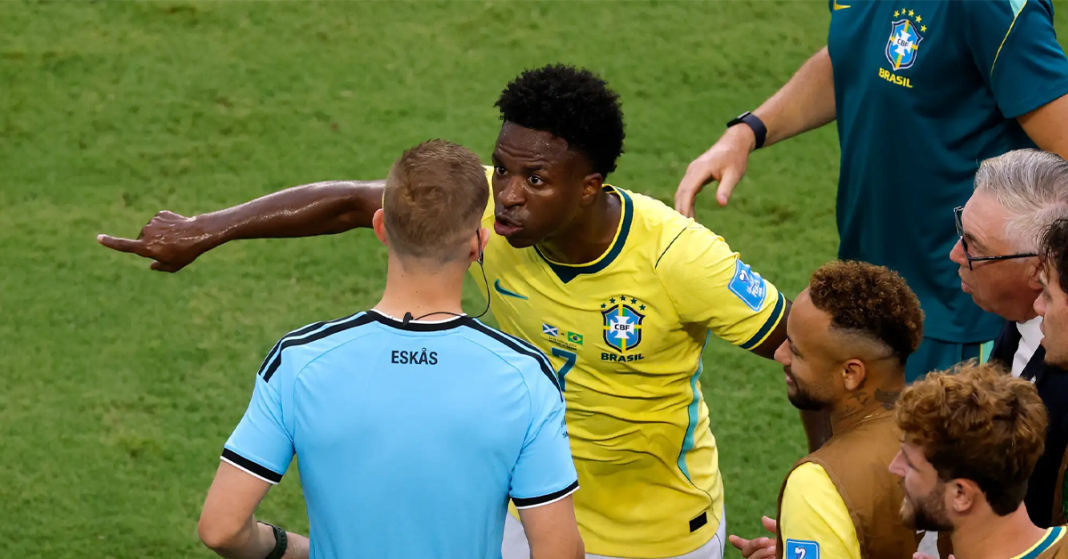
Securing a 3-0 victory over Scotland to close out the group stage smoothly, the Brazilian Football Confederation (CBF) still decided to send an official complaint to FIFA President Gianni Infantino. The incident stemmed from the controversial decision of referee Cesar Ramos when disallowing a goal by Vinicius Jr.

The situation occurred in the 21st minute, at a time when Brazil was leading. Vinicius stole the ball from Jack Hendry’s feet and then finished to beat goalkeeper Angus Gunn. Referee Ramos initially allowed the goal, but after VAR intervened, he changed his decision, considering that the Brazilian forward committed a foul before finishing.
CBF President, Mr. Samir Xaud, directly sent a document requesting FIFA not to allow this Mexican referee to officiate Brazil’s matches in the future. According to documents accessed by the newspaper Estadao, CBF recalled that they previously had a bad experience with Mr. Ramos in the match against Switzerland at the 2018 World Cup.
Notably, Brazil also used Lionel Messi’s goal in the match between Argentina and Austria as an example. The CBF argued that challenges of a similar intensity are still allowed for other teams, creating an inconsistency in officiating. The complaint also pointed out that even the Scottish players on the pitch at that time appeared surprised when VAR intervened and overturned the goal.

Despite the noise from the Confederation, coach Carlo Ancelotti is still placing his full focus on the match against Japan in the round of 32 taking place in Houston. In the recent match, after the situation where his goal was stripped away, Vinicius still managed to get his name on the scoresheet, along with Matheus Cunha’s strike to seal the 3-0 victory.
Assessing his players’ performance, coach Ancelotti said: “Our goal is to play as a collective. The team is not perfect yet and can still handle the ball faster. But I am satisfied because the whole team played solidly. In the knockout stage, firmness is very important. Compared to the opening match, we made fewer mistakes, got into our rhythm better, and played more effectively in attack.”